
Ethnic Aikawa (4): A Place to Return to – A Vietnamese Temple in the Hills

Leaving the Cambodian Festival and Heading to Our Original Destination

We had unexpectedly stumbled upon a Cambodian festival. I never imagined that we would encounter a festival drawing such a large number of Cambodians in the hills of Aikawa.
It had turned into quite a detour, but there was actually another reason we had been driving along this road in the first place. We had heard that there was a Vietnamese Buddhist temple farther ahead.Leaving the Cambodian temple behind, we got back in the car and continued on our way.
Around us was a thoroughly rural Japanese landscape, surrounded by the Nakatsu River and mountains.
Could there really be a Vietnamese temple somewhere out here?
Just as I was beginning to wonder…
There it was.

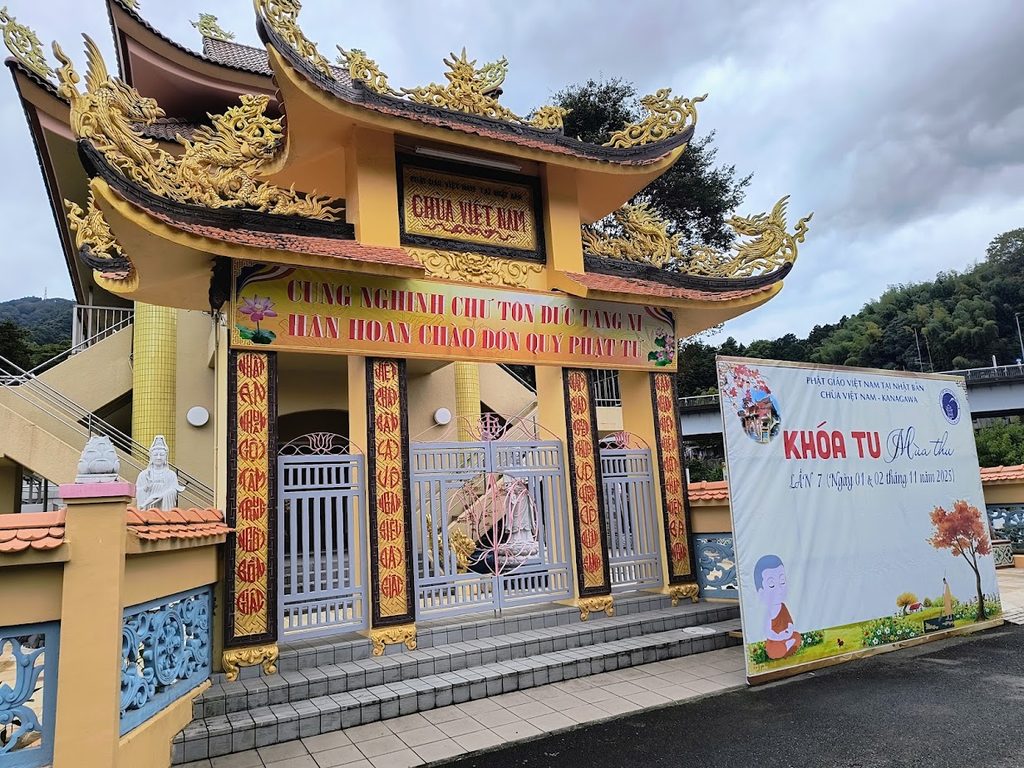
A predominantly yellow building decorated with dragons. Against the surrounding Japanese countryside, the atmosphere of this one place seemed completely different, almost as though it had been cut out of another landscape and placed here.
Chùa Việt Nam – A Vietnamese Temple in the Japanese Countryside
We passed through the gate and entered the temple grounds.
The Cambodian temple we had just visited had been in the middle of a festival, crowded with people and full of activity. This place, by contrast, was quiet.
The building was decorated with dragons and other ornaments, and its use of color was quite different from that of a Japanese Buddhist temple.
There was also a white statue of Kannon on the grounds.There was no question that this was a temple from another cultural tradition, and yet something about it also felt familiar.
Vietnam and Japan have both been strongly influenced by Mahayana Buddhism, and both are part of the broader cultural sphere historically shaped by Chinese characters. Perhaps that was why I felt a certain familiarity here that I had not experienced in quite the same way when visiting temples in Cambodia or Thailand.
Once inside, it became even clearer that this was not simply a building designed to “look foreign.” It was genuinely being used as a place of worship.
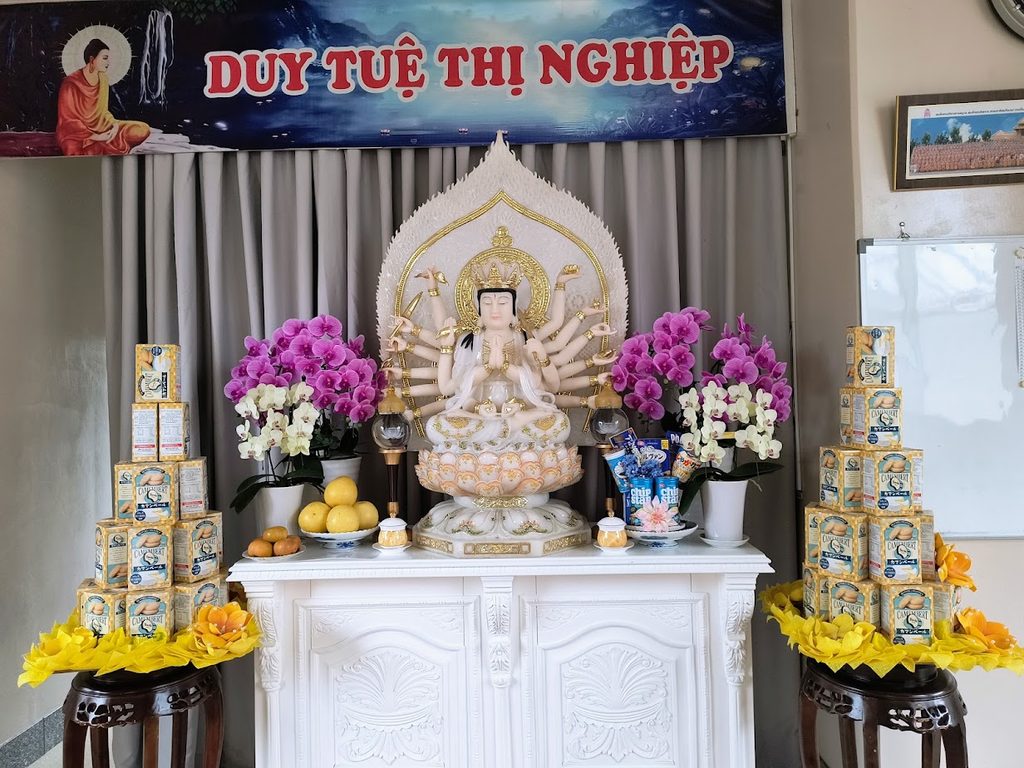
Buddhist statues were enshrined inside, offerings had been placed before them, and Vietnamese writing could be seen around the temple.

It was different from a Japanese temple, but not completely different.
The sight of fruit and sweets being offered before Buddhist images, for example, was reminiscent of offerings at a Japanese family Buddhist altar.
As Buddhism traveled from India through China to Vietnam and Japan, it blended with the culture of each place along the way. Even within the same religion, the buildings, Buddhist images, and ways of praying change from one country to another.
Visiting a temple like this in person makes those differences especially interesting.
A Place to “Come Home To”
A Vietnamese woman came out of the building next door and spoke to us.She told us that on weekends, Vietnamese people gather at this temple not only from around Aikawa, but also from Tokyo and Saitama, and sometimes from even farther away.They recite sutras together, share meals, and stay overnight.

For Vietnamese people, she explained, the temple is less a place they simply “go to” than a place they “come home to.
”Perhaps that takes on an even greater meaning precisely because they are living in a foreign country.
Here they can speak the language of their homeland, reconnect with its religion, and share meals together. For children born in Japan, it can also be a place to learn about the culture of their parents’ or grandparents’ country.
This may be a Buddhist temple, but for Vietnamese people living in Japan, it also seems to serve as a kind of second home.
We Were Even Invited Back for a Meal
To our surprise, she told us that if we contacted them in advance, we could come back and eat with everyone. Apparently, the meal would be Buddhist vegetarian cuisine.She encouraged us to visit again.The head priest is Vietnamese and is invited from Vietnam, but the Vietnamese people who gather here live in Japan and speak Japanese. Japanese visitors are welcome as well.
That could make for a rather unusual experience.
The Role of Foreign Temples in Japan
During our day exploring Aikawa, we had visited a South American supermarket, a Peruvian cake shop, a Cambodian temple, and now a Vietnamese temple.
When we think about people from other countries living in Japan, the first things we tend to notice are restaurants and grocery stores.
But life is about more than food.There is religion. There are connections with other people. And people also need somewhere they can turn when they are in trouble.
In fact, some Vietnamese temples in Japan serve not only as places of worship, but also as community hubs and places that provide support for people facing difficulties in their daily lives.
An increase in the number of foreign residents in Japan does not simply mean an increase in the number of foreign restaurants.
It means that their lives themselves — their communities, their connections, and the places important to them — are gradually becoming part of life in Japan.
Aikawa, Kanagawa Prefecture
October 19, 2025
[1] A South American Supermarket Blending into the Neighborhood
[2] A Taste of Home- A Peruvian Cake Shop
[3] An Unexpected Khmer Festival
[4] A Place to Return to – A Vietnamese Temple in the Hills
\ Get the latest news /
